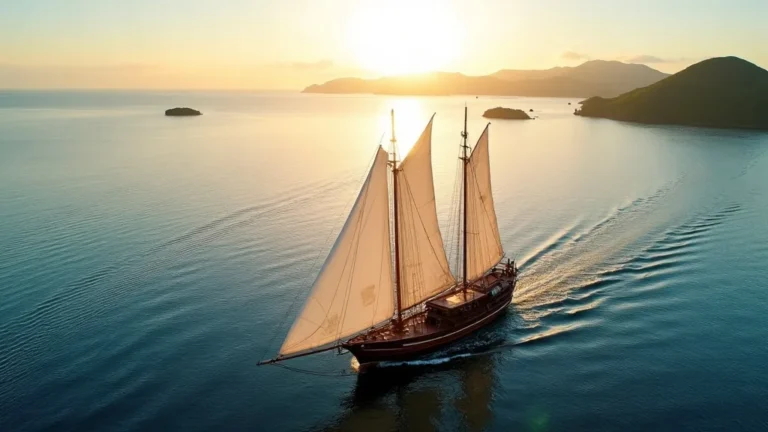
From Bali Resort to Liveaboard Bunk: Your First Night at Anchor in Komodo
You wake up in Seminyak or Ubud with a pool three steps from the bed, and forty-eight hours later you are lying inside a wooden hull in Komodo National Park, listening to an anchor chain settle in the dark. Almost nobody explains what happens in between. Resorts publish spa menus; boats publish itineraries; the actual experience of your first night at anchor — the sounds, the schedule, the small adjustments — sits in a gap that first-timers usually fill with guesswork.
This guide closes that gap. We spend our days helping travellers plan Komodo liveaboard journeys that begin in Bali, and the questions we hear most are never about dragons or manta rays. They are about night one. Will I sleep? Is there hot water? What happens when the generator changes pitch at midnight? Here is what really changes when you trade a resort room for a cabin at anchor, and how to make the switch feel like an upgrade instead of a shock.
The Handover Day: Leaving the Bali Bubble
The transition starts before you ever see the boat. Most guests take a short morning hop from Bali across to Labuan Bajo — the Flores harbour town that opens the gate to the park. Arrive a day ahead of departure if you can, or on the earliest flight of the morning if you cannot, because boats sail to a schedule and a single delay can ripple through your whole first day. A resort will hold your room until midnight; a boat with a tide table and a park permit will not wait in the same way.
One practical detail catches people out: liveaboard pick-ups generally cover mainland Labuan Bajo hotels and the airport near the harbour — not accommodation on the surrounding islands. If you are tempted by an island resort for your pre-boat night, check the transfer terms before you book it. A water taxi at dawn with your luggage is not the calm start you are picturing.
Boarding Day, Hour by Hour
A typical shared departure collects guests around nine in the morning and is sailing by mid-morning. The first hours set the tone: a safety briefing, a cabin tour, lunch under way, then a first island stop for a short trek or a snorkel while the crew resets the deck. By late afternoon the boat noses into a sheltered anchorage, the engine shuts down, and the trip properly begins.
That engine shutdown is the moment resort life officially ends. The quiet is startling for a few seconds, and then the smaller sounds arrive. Water taps against the hull. The anchor chain shifts as the boat swings with the current. Somewhere below decks a generator hums. This is the soundtrack of your next few nights, and most guests tell us that by night two they cannot imagine sleeping without it.
Your Cabin After Dark: What Anchor Sleep Actually Feels Like
Forget the horror stories about heaving seas. At anchor in a sheltered bay, movement is a slow, patient rock — closer to a hammock than a rollercoaster. The adjustment is less about motion and more about rhythm. Your cabin is smaller than your resort room, so unpacking into the drawers on arrival, rather than living out of a suitcase, changes everything about how the space feels. Sea-view cabins give you a horizon from the bed; porthole cabins trade the panorama for a snug, ship-like cosiness that many solo travellers and deep sleepers actually prefer.
Two adjustments help on night one. First, pack earplugs even if you never use them at home — not for noise, but for the novelty of noise, because unfamiliar sounds wake you more than loud ones. Second, if you are prone to motion sickness, take your preferred remedy before the boat leaves the harbour, not after you feel the first swell. By the time you feel it, you are chasing it.
Generator Hours, Hot Showers, and the Wi-Fi Question
Everything electric on a liveaboard — air-conditioning, lights, charging sockets, the water pump behind your hot shower — runs on generators, and every boat manages them differently. Some run power around the clock; others cycle generators down during the day when guests are off snorkelling. Ask three questions before you book: does the air-conditioning run all night, are the bathrooms genuinely hot-water, and where do I charge my camera? On a well-run premium boat the answers are yes, yes, and in your cabin. On a budget boat the answers get vaguer, and that vagueness is exactly what you feel at 3 a.m.
Then there is signal. Expect a workable connection around Labuan Bajo and long dead zones deeper inside the park. Better boats carry onboard Wi-Fi, and it is genuinely useful, but treat it as messaging-grade rather than streaming-grade and you will never be disappointed. Download your maps, playlists and reading before you leave Bali, tell people at home you will be intermittently reachable, and let the park do what it does to a busy mind.
Dinner at Anchor: The Galley Is the Quiet Hero
Resort dining is about choice; boat dining is about rhythm, and the rhythm wins. Meals arrive at set times, cooked in a galley you could touch from your seat, and eaten either in the saloon or out on deck with the anchorage around you. On chef-crewed boats the standard is far higher than first-timers expect — think Indonesian and Western dishes built around the day’s activities, with coffee and tea flowing between them. Two things to know in advance: alcohol is usually excluded rather than included, so ask about policy and pricing before you board, and dietary requirements are handled well only when they are declared at booking, not at the first dinner.
Choosing a First Boat That Makes Night One Easy
Everything above gets dramatically easier on a vessel designed around comfort rather than merely decorated with it. The features that matter on your first night are unglamorous on a brochure: en-suite bathrooms with reliable hot water, air-conditioning that actually runs while you sleep, an indoor saloon to retreat to, and a crew large enough that someone is always awake and unhurried.
If you want a current, concrete example of that standard, look at the Elbark liveaboard — a 37 m hull in service from October 2022, sleeping 21 guests at most across nine air-conditioned en-suite cabins on three levels, run by a 12-plus crew that includes a dedicated chef and a cruise director. It carries precisely the night-one comforts this guide keeps returning to: hot-water bathrooms, an air-conditioned indoor salon, onboard Wi-Fi, and a sky deck for that first sunset at anchor. Friday shared departures on the three-day, two-night format carry cabin-graded pricing with a USD 400 entry berth; taking the whole boat opens at USD 8,400 across a two-day, one-night block with as many as ten aboard. Reservations sit solely with Komodo Luxury — a TripAdvisor Travelers’ Choice 2025 agency, per Komodo Luxury’s own listing — reachable on WhatsApp +62 811 3823 875 and at [email protected].
Before Lights Out: The Night-One Essentials
- Earplugs and an eye mask — for the novelty of new sounds, not the volume of them.
- Seasickness remedy, taken early — before the harbour, not after the first swell.
- A charged power bank — so generator schedules never dictate your camera battery.
- Offline downloads — maps, music and reading saved before you leave Bali.
- A light layer — sea breeze after sunset runs cooler than a resort evening.
- Low expectations for signal, high ones for sleep — the trade is better than it sounds.
The first night at anchor is not a downgrade from your resort; it is a different instrument entirely. The pool is gone, but in its place is a bay full of stars, a hull that rocks you to sleep, and a sunrise you will watch from the deck with coffee in hand before the day’s first trek. Cross the gap deliberately — right boat, right questions, right small preparations — and by morning you will wonder why anyone stays on shore.